
Stand on the roof of Africa on our 7-day Kilimanjaro expedition via the legendary Machame Route — the most scenic and popular path to Uhuru Peak at 5,895 meters. Known as the "Whiskey Route" for its challenging but rewarding nature, Machame traverses five distinct ecological zones, from lush rainforest to alpine desert to arctic glacier, offering an ever-changing panorama that makes every step worthwhile. Our extended 7-day itinerary (versus the standard 6-day) includes an extra acclimatization day at Karanga Camp, significantly improving summit success rates to over 95%. With experienced Kilimanjaro guides, a dedicated team of porters, and full camping support, you can focus entirely on the incredible journey to Africa's highest point.
Uhuru Peak — Africa's highest point
Rainforest to arctic glacier
7-day itinerary with acclimatization
Certified guides & dedicated porters
The best climbing seasons are the dry months of January through March and June through October. January-March offers warmer conditions with clear skies and snow-capped peaks — ideal for photography. June-October is cooler but also dry and stable, with the busiest period being July-August. Avoid the rainy seasons of April-May and November-December when trails become muddy and dangerous. The 7-day itinerary provides sufficient acclimatization regardless of season, but clear weather significantly enhances the summit experience and views.
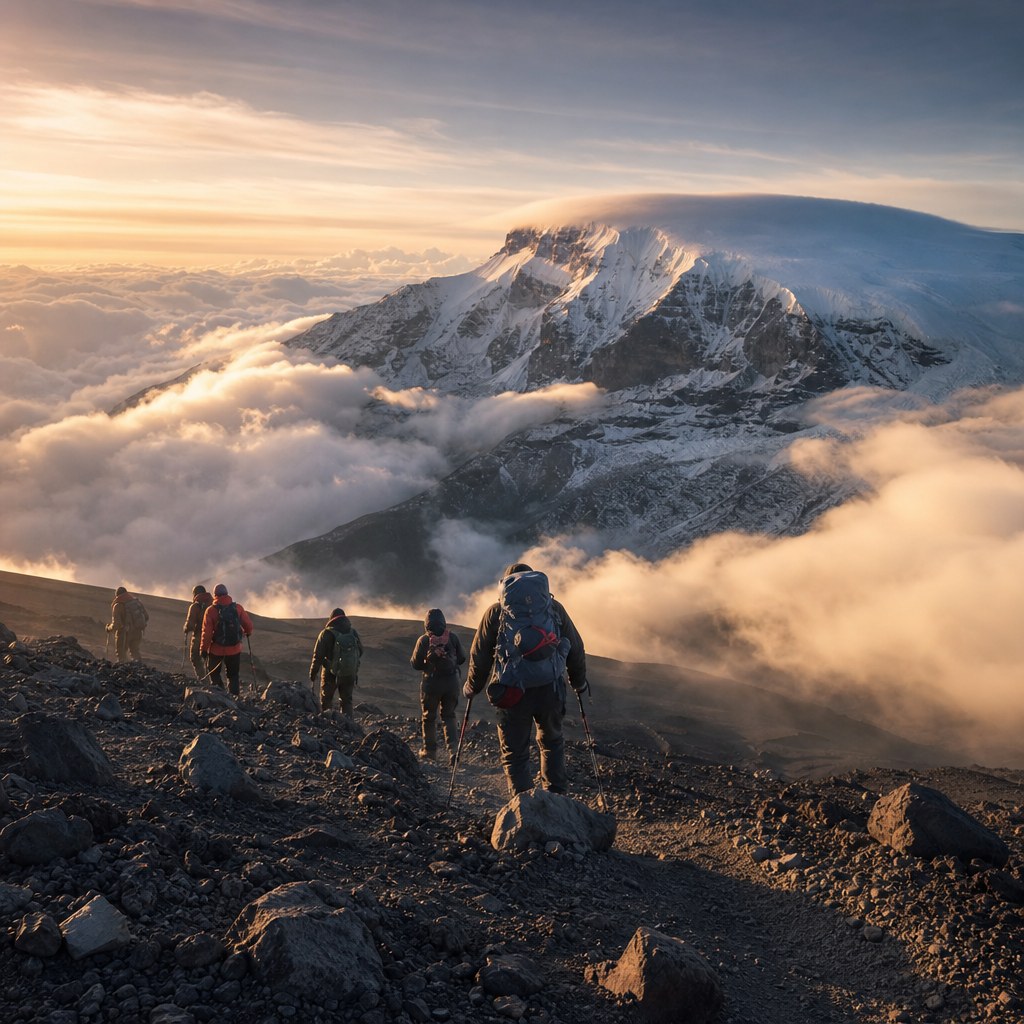
After breakfast at your Arusha or Moshi hotel, drive to the Machame Gate (1,490m) where you'll complete park registration and meet your trekking team — lead guide, assistant guide, cook, and porters. The trail begins in lush montane rainforest, winding through towering trees draped in moss and lichen, with colobus monkeys calling from the canopy. The 11 km trek to Machame Camp (2,980m) takes approximately 5–6 hours, gaining 1,490 meters of elevation. The forest gradually gives way to heath and moorland as you climb. Arrive at camp in the late afternoon where your tent is already set up and hot tea and snacks await. Dinner is served in the dining tent. Altitude begins to make itself felt — walk slowly and drink plenty of water.
Wake to hot tea served at your tent, then enjoy breakfast before setting out. Today's trail leaves the forest behind and enters the heath and moorland zone, with giant senecio plants and lobelias dotting the landscape. The path climbs steadily to a ridge with stunning views of Kibo Peak before descending slightly to the Shira Plateau — a high-altitude caldera formed by Kilimanjaro's ancient eruptions. The 5 km trek to Shira Camp (3,500m) takes approximately 4–5 hours. The camp sits on the plateau with panoramic views of the Western Breach and the glaciers above. Afternoon is for rest and acclimatization — your guide will lead a short acclimatization walk to a nearby viewpoint. The air is noticeably thinner here.
This is a crucial acclimatization day following the "climb high, sleep low" principle. From Shira Camp, the trail climbs steadily toward the dramatic Lava Tower (4,630m), a 300-foot volcanic plug rising from the mountainside. You'll reach this altitude before descending to Barranco Camp — the high point helps your body adapt while the lower sleep altitude aids recovery. The landscape transitions to alpine desert — sparse vegetation, volcanic rock, and dramatic skies. After lunch near Lava Tower, descend into the Barranco Valley, passing the Great Barranco Wall that you'll climb tomorrow. The 15 km trek takes approximately 7–8 hours. Barranco Camp (3,960m) sits in a spectacular valley below the imposing Barranco Wall, with Kibo Peak towering above. This is many climbers' favorite camp.
Today begins with the exhilarating scramble up the Barranco Wall — a 257-meter near-vertical rock face that looks intimidating but is surprisingly manageable with your guide's direction. The views from the top are breathtaking, with clouds often swirling below you. After the wall, the trail undulates through alpine desert terrain, crossing ridges and valleys with Kibo Peak always in view. You'll pass the Karanga Valley, the last water point on the mountain, before a final climb to Karanga Camp (4,035m). This is our extra acclimatization camp — the key to our high summit success rate. The short 5 km trek (4–5 hours) gives you the afternoon to rest, hydrate, and let your body adjust to the altitude. Your guide will monitor your oxygen saturation and heart rate.
A relatively short but steep day as you climb from Karanga Camp to Barafu Camp (4,673m), the base camp for the summit push. The trail crosses the alpine desert, passing the Mweka Trail junction before ascending a rocky ridge to Barafu — which means "ice" in Swahili. The 4 km trek takes approximately 4–5 hours, arriving at camp by early afternoon. This gives you crucial rest time before the midnight summit attempt. Your guide will brief you on the summit strategy, check your gear, and ensure you eat and drink as much as possible. An early dinner is served, and you'll be encouraged to sleep by 6:00 PM. The summit push begins at midnight. Rest well — tomorrow will be the most challenging and rewarding day of your life.
Midnight arrives, and your guide wakes you for the summit push. Dressed in layers, headlamp on, you begin the grueling 1,222-meter ascent to Uhuru Peak. The trail climbs steeply through volcanic scree and snow fields, switchbacking between Stella Point (5,739m) and the summit. The physical and mental challenge is immense — cold, darkness, altitude, and fatigue test every fiber of your being. But as dawn breaks near Stella Point, the most spectacular sunrise in Africa unfolds before you — the curvature of the Earth visible on the horizon, Mawenzi Peak glowing in the distance, and the vast African plains stretching endlessly below. From Stella Point, it's a 45-minute traverse along the crater rim to Uhuru Peak (5,895m), passing the iconic sign and the retreating glaciers. Photos, tears, triumph. Then descend — first to Barafu for lunch, then continue down to Mweka Camp (3,100m). A 14–16 hour day, but one you'll never forget.
The final descent through the lush rainforest to Mweka Gate (1,490m) takes approximately 3–4 hours. The trail is steep and can be muddy — trekking poles are essential. As you descend, the air thickens, the vegetation becomes denser, and you'll likely feel a mixture of exhaustion and elation. At Mweka Gate, sign the official register and receive your summit certificate — gold for Uhuru Peak, green for Stella Point. This is a moment of immense pride. Your porters will sing the Kilimanjaro song ("Hakuna Matata") in celebration. A vehicle will be waiting to drive you back to your hotel in Moshi or Arusha, where a hot shower and comfortable bed await. For those wanting to extend their adventure, we can arrange a safari or Zanzibar beach extension.
Prices are per person. Private treks and group joins available.
| Option | Group Size | Price (PP) | Single Tent | Status |
|---|---|---|---|---|
| Group Join | 4–12 people | $2,200 | $150 | Available |
| Private (2 pax) | 2 people | $2,800 | Included | Available |
| Private (3–4 pax) | 3–4 people | $2,500 | $150 | Available |
Our 7-day itinerary with extra acclimatization achieves over 95% summit success. All prices include park fees, rescue fees, guide and porter team, meals, and camping equipment.
| Day | Camp | Altitude | Zone |
|---|---|---|---|
| Day 1 | Machame Camp | 2,980m | Heath / Moorland |
| Day 2 | Shira Camp | 3,500m | Moorland |
| Day 3 | Barranco Camp | 3,960m | Alpine Desert |
| Day 4 | Karanga Camp | 4,035m | Alpine Desert |
| Day 5 | Barafu Camp | 4,673m | Alpine Desert / Arctic |
| Day 6 | Mweka Camp | 3,100m | Rainforest |
Fly into Kilimanjaro International Airport (JRO), approximately 40 km from Moshi and 60 km from Arusha. Most international airlines serve JRO. We include one night's pre-trek accommodation in Moshi, so plan to arrive at least one day before the trek begins.
We provide complimentary pickup from any hotel in Arusha or Moshi, or from Kilimanjaro International Airport. The drive to Machame Gate takes approximately 1.5 hours from Moshi or 2.5 hours from Arusha. Departure time is typically 8:00 AM on Day 1.
We provide a detailed packing list upon booking. Essential items include: waterproof trekking boots (broken in!), 4-season sleeping bag (-10°C rating), down jacket, thermal layers, waterproof shell, headlamp, trekking poles, and a 30-40L daypack. Rental equipment is available in Moshi at reasonable prices.
Most nationalities can obtain a visa on arrival at JRO for USD $50 (USD $100 for US citizens). A valid passport with at least 6 months remaining is required. Mandatory travel insurance covering high-altitude trekking and helicopter evacuation must be obtained before the trek.
Arusha, Tanzania • Established 2015
Nashivai Safaris is a locally owned and operated safari and trekking company based in Arusha, Tanzania. Our Kilimanjaro division is led by guides who have summited over 200 times each, and our porter team is among the best-treated on the mountain — we exceed KPAP fair-treatment standards. Our 7-day Machame itinerary with extra acclimatization achieves a 95%+ summit success rate, one of the highest in the industry.
"Summiting Kilimanjaro was the hardest and most incredible thing I've ever done. Our guide Joseph was extraordinary — his calm confidence kept me going when I wanted to quit at 5,000m. The extra acclimatization day made all the difference. The porters are absolute heroes. Life-changing experience."
— Michael R., Germany • January 2025"The sunrise from Stella Point was the most beautiful thing I've ever seen. I cried. Our whole group of 8 made it to Uhuru Peak, which the guides said was unusual for a group that size — testament to their pacing and care. The food on the mountain was surprisingly good. Nashivai runs a first-class operation."
— Emma & James P., UK • August 2024
