
The Northern Circuit is Kilimanjaro's newest, longest, and most scenic route, offering the highest summit success rate of any trail on the mountain — up to 95%. Beginning at the remote Londorossi Gate on the western side, the route follows the classic Lemosho approach through pristine rainforest before branching northward across the vast Shira Plateau. From Lava Tower, instead of continuing south like other routes, the Northern Circuit traverses eastward along the remote northern slopes beneath the Northern Ice Fields — terrain virtually untouched by other trekkers. This extended "climb high, sleep low" approach provides exceptional acclimatization, with gradual altitude gains and multiple adaptation opportunities. The route then joins the summit approach via School Hut before the final push to Uhuru Peak. With nine days on the mountain, the Northern Circuit is the gold standard for summit success on Kilimanjaro.
Highest on Kilimanjaro
Northern slopes — few trekkers
9 days with gradual altitude gains
Uhuru Peak — Africa's highest point
The Northern Circuit Route is best climbed during the dry seasons of January through March and June through October. January-March offers warmer conditions with spectacular clear skies and the mountain's snow-capped peaks are at their most photogenic. June-October is cooler but dry and stable, with excellent visibility. The rainy seasons of April-May and November-December should be avoided — the remote northern slopes become difficult to navigate, and the Shira Plateau can become waterlogged. Because the Northern Circuit spends more time at altitude than any other route, good weather is especially important for comfort and safety. We particularly recommend January-February and September-October for the optimal combination of dry conditions, manageable temperatures, and stunning visibility across the Shira Plateau and northern slopes.
Upon arrival at Kilimanjaro International Airport (JRO), you will be warmly welcomed by a Nashivai Safaris representative holding a personalized sign. Enjoy a private transfer to the Kiliwonders Hotel in Moshi, a comfortable property nestled at the base of Mount Kilimanjaro with stunning views of the mountain you are about to climb. Settle in, freshen up after your flight, and take in the tropical gardens and the sight of Kibo Peak rising above the clouds. Later in the day, meet your lead mountain guide for a comprehensive climb briefing — covering the Northern Circuit's unique characteristics, the extended acclimatization strategy, daily schedule, and altitude management. Your guide will also conduct a thorough equipment inspection to ensure you have everything needed for this nine-day expedition. Any missing items can be rented in Moshi the following morning. This is your opportunity to ask questions and address any concerns before the adventure begins.
After breakfast, drive approximately two hours to Londorossi Gate (2,100m) on Kilimanjaro's western side. Registration formalities are completed at the gate, and you will meet your full mountain crew — assistant guides, cook, and porters who will be your support team for the next eight days. The trek begins through pristine montane rainforest, following a vehicle track for the first section before branching onto a narrow forest trail. This is the same starting approach as the Lemosho Route, and the forest here is exceptionally beautiful — towering trees draped in old man's beard, giant ferns, and moss-covered boulders create a primeval atmosphere. Colobus monkeys are frequently seen crashing through the canopy, and the birdlife is prolific. The trail gradually gains altitude as you walk through the forest, eventually arriving at Mti Mkubwa Camp (2,650m) — "Big Tree Camp" — nestled in a forest clearing. The 8 km trek takes approximately 3-4 hours, giving you a gentle first day on the mountain and plenty of time to settle into camp life.
Today the trail climbs out of the rainforest and into the lower moorland zone as you approach the edge of the Shira Plateau. The vegetation changes dramatically — giant heather and lobelia replace the dense forest, and the landscape opens up with your first unobstructed views of Kibo Peak rising dramatically above the plateau. The trail continues across the western edge of the Shira Plateau, a vast volcanic caldera formed by ancient eruptions, before arriving at Shira 1 Camp (3,500m). The camp sits on the plateau floor with panoramic views of Kibo and the Western Breach, and on clear days you can see Mount Meru rising far to the west. The 5 km trek takes approximately 4-5 hours, and you arrive with plenty of time to rest and begin adjusting to the higher altitude. Your guide will check your oxygen saturation and heart rate as part of the daily health monitoring routine.
A relatively gentle day as you traverse eastward across the vast Shira Plateau toward Shira 2 Camp (3,850m). This is one of the most scenic walks on the entire mountain — the plateau is a high-altitude semi-desert of volcanic rock, sparse vegetation, and dramatic skies. The massive cone of Kibo dominates the view ahead, while the jagged peaks of the Cathedral and the Tower rise to the north. You may spot augur buzzards soaring overhead and eland occasionally wandering across the plateau. The gentle gradient allows for relaxed walking and excellent acclimatization — this is the "climb high, sleep low" principle in action, as you gain only 350 meters over 7 km in approximately 3-4 hours. After lunch at Shira 2, your guide may offer an optional afternoon acclimatization hike toward the Cone Formation or along the plateau rim for additional altitude adaptation.
This is a critical acclimatization day. The trail climbs steeply from Shira 2 toward the dramatic Lava Tower (4,600m) — a towering volcanic plug that rises 90 meters from the surrounding slopes. The landscape becomes increasingly barren and otherworldly as you ascend into the alpine desert zone, with scattered volcanic boulders and virtually no vegetation. Reaching Lava Tower is a significant achievement — at 4,600m you have climbed high, and your body is working hard to adapt. Spend time here for lunch and acclimatization before the trail turns northward, descending slightly toward the remote Moir Hut Camp (4,200m). This is where the Northern Circuit diverges from all other routes — while Lemosho and Machame trekkers continue south toward Barranco, you turn north into the remote northern wilderness. Moir Hut sits in a valley below the Northern Ice Fields, a stunning and rarely visited area. The 12 km trek takes approximately 6-7 hours. This "climb high, sleep low" day is one of the most important acclimatization days on the entire itinerary.
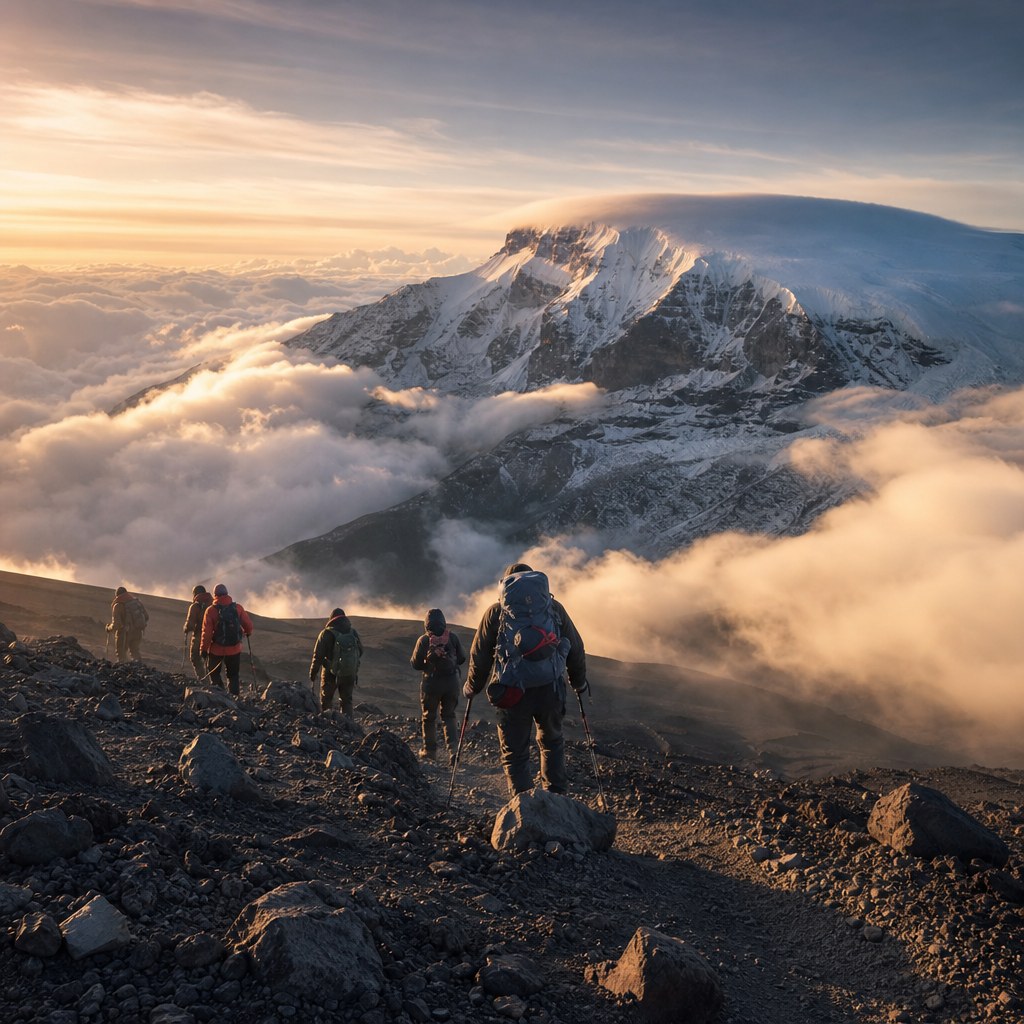
Today you traverse eastward along Kilimanjaro's remote northern slopes — a section of the mountain that virtually no other trekkers visit. The trail follows the contour of the mountain beneath the Northern Ice Fields, with stunning views of Kibo's dramatic north face and the dry lands of Kenya stretching endlessly to the north. This is wilderness trekking at its finest — you are unlikely to see another group all day. The landscape transitions from rocky alpine desert to more gently undulating terrain with patches of alpine grassland. As you descend gradually toward Third Cave Camp (3,800m), the vegetation begins to return — hardy senecio plants and small lobelias dot the landscape, and small streams provide fresh water. The 9 km trek takes approximately 5-6 hours, with another beneficial "sleep low" night that further enhances your acclimatization. Third Cave Camp sits in a sheltered hollow with views toward the Kenyan plains — a truly exclusive campsite.
Today you climb back up toward the high-altitude zone as the trail ascends from Third Cave toward School Hut (4,800m). The landscape transitions from alpine meadow back to rocky volcanic terrain as you gain altitude. The trail is relatively short but steep, climbing approximately 1,000 meters over 5 km in about 4-5 hours. As you ascend, the vegetation disappears entirely and you enter the high alpine desert zone once again — volcanic ash, scattered boulders, and the vast openness of Kilimanjaro's upper slopes. School Hut Camp sits at 4,800m and is your base camp for the summit push. This camp is significantly less crowded than Barafu Camp, offering a quieter and more peaceful final night before the summit attempt. Your guide will conduct a detailed summit briefing — covering the timing, pacing, clothing layering strategy, and emergency procedures. Gear is checked one final time, and you are encouraged to eat and drink as much as possible. An early dinner is served, and you will be urged to sleep by 6:00 PM. The summit push begins around midnight.
Around midnight, your guide wakes you for the summit push. Dressed in every layer you possess, headlamp cutting through the darkness, you begin the grueling ascent toward Uhuru Peak. From School Hut, the trail climbs steeply through volcanic scree toward Stella Point (5,739m) on the crater rim — a 1,095-meter gain that takes 5-6 hours in the cold darkness. The physical and mental challenge is immense — cold, darkness, altitude, and fatigue test every fiber of your being. But as dawn breaks near Stella Point, the most spectacular sunrise in Africa unfolds before you — the curvature of the Earth visible on the horizon, Mawenzi Peak glowing orange across the saddle, and the vast African plains stretching endlessly below. From Stella Point, continue along the crater rim through snow fields and past the retreating glaciers to Uhuru Peak (5,895m) — the highest point on the African continent. Photos, tears, triumph. Your excellent acclimatization from nine days on the mountain makes this moment far more achievable than on shorter routes. After summit celebrations and official photographs, descend past School Hut and Barafu before continuing down to Mweka Camp (3,100m) for a well-earned rest. A 14-16 hour day, but one that will live in your memory for the rest of your life.
Enjoy your final morning on the mountain before descending through lush rainforest to Mweka Gate (1,640m). The trail is steep and can be muddy — trekking poles are essential. As you descend, the air thickens, the vegetation becomes denser, and birdsong replaces the silence of the high camps. The 8 km trek takes approximately 3-4 hours. Upon arrival at Mweka Gate, successful climbers will receive their Official Kilimanjaro National Park Summit Certificate during a special certificate presentation ceremony recognizing their achievement of reaching Africa's highest peak — gold for Uhuru Peak, green for Stella Point. Your porter team will gather to sing the traditional Kilimanjaro song in celebration. Bid farewell to your mountain crew before transferring to Kilimanjaro International Airport or your hotel for onward travel. With the Northern Circuit's exceptional acclimatization, you have earned the summit with the highest success rate on Kilimanjaro — an achievement that will last a lifetime.
Prices are per person. Private treks and group joins available. All prices include park fees, rescue fees, hotel, and full crew support.
| Season | Option | Group Size | Price (PP) | Single Tent | Status |
|---|---|---|---|---|---|
| Low Season Apr-May, Nov | Group Join | 4-12 people | $2,800 | $150 | Available |
| Private | 2-3 people | $3,500 | Included | Available | |
| High Season Jan-Mar, Jun-Oct | Group Join | 4-12 people | $3,100 | $150 | Available |
| Private | 2-3 people | $3,800 | Included | Available | |
| Peak Season Jul-Aug, Dec | Group Join | 4-12 people | $3,350 | $150 | Available |
| Private | 2-3 people | $4,050 | Included | Available |
Our 9-day Northern Circuit itinerary provides the best acclimatization of any Kilimanjaro route, with gradual altitude gains, a "climb high, sleep low" approach at Lava Tower, and remote northern slopes traverses. All prices include Kilimanjaro National Park fees, rescue fees, hotel in Moshi, guide and porter team, meals, and camping equipment.
| Day | Camp | Altitude | Zone |
|---|---|---|---|
| Day 1 | Kiliwonders Hotel, Moshi | 900m | Town |
| Day 2 | Mti Mkubwa Camp | 2,650m | Montane Rainforest |
| Day 3 | Shira 1 Camp | 3,500m | Moorland |
| Day 4 | Shira 2 Camp | 3,850m | Moorland / Alpine Desert |
| Day 5 | Moir Hut Camp | 4,200m | Alpine Desert |
| Day 6 | Third Cave Camp | 3,800m | Alpine Desert / Moorland |
| Day 7 | School Hut | 4,800m | Alpine Desert / Arctic |
| Day 8 | Mweka Camp | 3,100m | Rainforest |
Fly into Kilimanjaro International Airport (JRO), approximately 40 km from Moshi and 60 km from Arusha. International connections are available through Qatar Airways (Doha), Turkish Airlines (Istanbul), KLM Royal Dutch Airlines (Amsterdam), Ethiopian Airlines (Addis Ababa), and Kenya Airways (Nairobi). Airport transfers are included in your package — our representative will meet you at arrivals with a personalized sign.
Included airport transfer takes you directly to the Kiliwonders Hotel in Moshi — a comfortable property with views of Kilimanjaro, tropical gardens, and a swimming pool. The hotel is your base for the night before the trek begins. On Day 2, departure to Londorossi Gate is at approximately 7:30 AM. The drive takes about two hours from Moshi through lush farmland on Kilimanjaro's western slopes to the Londorossi Gate registration point.
We provide a detailed packing list upon booking. Because the Northern Circuit traverses remote northern slopes where weather can change rapidly, waterproof and warm gear is essential. Key items include: waterproof trekking boots (broken in!), 4-season sleeping bag (-10°C rating), down jacket, thermal base layers, waterproof shell jacket and pants, headlamp with spare batteries, trekking poles (essential for the descent), warm hat and gloves, and a 30-40L daypack. Any missing items can be rented in Moshi on Day 1 — sleeping bag ($50), down jacket ($40), and poles ($20).
Most nationalities can obtain a visa on arrival at JRO for USD $50 (USD $100 for US citizens). A valid passport with at least 6 months remaining and two blank pages is required. Mandatory travel insurance covering high-altitude trekking and helicopter evacuation must be obtained before the trek. Yellow fever vaccination certificate is required if arriving from endemic areas.
Arusha, Tanzania • Established 2015
Nashivai Safaris is a locally owned and operated safari and trekking company based in Arusha, Tanzania. Our Kilimanjaro division is led by guides who have summited over 200 times each, and our porter team is among the best-treated on the mountain — we exceed KPAP fair-treatment standards and are committed to ethical trekking practices. The Northern Circuit is our recommended route for trekkers who want the absolute highest chance of summit success. With nine days on the mountain, the extended acclimatization profile and remote northern slopes traverse make this the gold standard itinerary for standing on the Roof of Africa.
Up to 95% of trekkers on the Northern Circuit reach Uhuru Peak — the highest success rate of any Kilimanjaro route. Nine days of gradual acclimatization makes the critical difference.
The northern slopes see virtually no other trekkers. You will have the wilderness to yourself for days 5-7, a rare privilege on Kilimanjaro.
The "climb high, sleep low" approach at Lava Tower and the gradual traverse across the northern slopes give your body maximum time to adapt to altitude.
"The Northern Circuit was worth every extra day. We had the mountain to ourselves for three full days on the northern slopes — it felt like a true expedition rather than a tourist trek. Our guide Yusuf was incredible, monitoring our oxygen levels daily and adjusting the pace perfectly. When we reached Uhuru Peak, I felt strong and alert, not just surviving. That's the difference nine days makes. The Lava Tower acclimatization hike was a highlight — standing at 4,600m and then sleeping lower at Moir Hut is the key to this route's success."
— Sarah & James W., Australia • February 2025"I chose the Northern Circuit because I wanted the best possible chance of summiting after hearing horror stories about people failing on shorter routes. It was the right decision — 95% success is real. Every single person in our group of six made it to Uhuru Peak, and we all felt remarkably good. The remote northern traverse was the surprise highlight — stunning views of Kenya and the Northern Ice Fields with not another soul in sight. Nashivai's team was exceptional from start to finish."
— Dr. Michael K., Canada • September 2024