
Experience the road less traveled on our 8-day Kilimanjaro expedition via the Rongai Route — the only trail approaching Kilimanjaro from the remote northern side near the Kenyan border. Often called the "Nalemuru Route," Rongai offers a quieter, more wilderness-oriented experience than the popular Machame and Marangu routes, with dramatically fewer trekkers on the trail. The route traverses pristine moorland, passes beneath the dramatic spires of Mawenzi Peak, and crosses the haunting "Saddle" between Mawenzi and Kibo before the ultimate summit push to Uhuru Peak at 5,895 meters. Our 8-day itinerary includes a valuable acclimatization day at Mawenzi Tarn, allowing your body to adapt to the altitude and pushing summit success rates above 90%. The descent follows the Marangu Route on the southern side, giving you a complete circumnavigation experience with diverse landscapes on both ascent and descent.
Uhuru Peak — Africa's highest point
Quietest route on Kilimanjaro
8-day itinerary with acclimatization day
Rongai ascent + Marangu descent
The best climbing seasons on the Rongai Route are during the dry months of January through March and June through October. Because the Rongai Route is on the northern side — which receives significantly less rainfall than the southern slopes — it is actually the best route during the short rainy season of November-December, though trails can still be slippery. January-March offers warmer conditions with a dusting of snow near the summit and excellent photography conditions. June-October is the peak climbing season with cooler, dry weather. The 8-day itinerary with the Mawenzi Tarn acclimatization day provides excellent altitude adaptation regardless of season, but clear weather dramatically improves summit views and the overall experience.
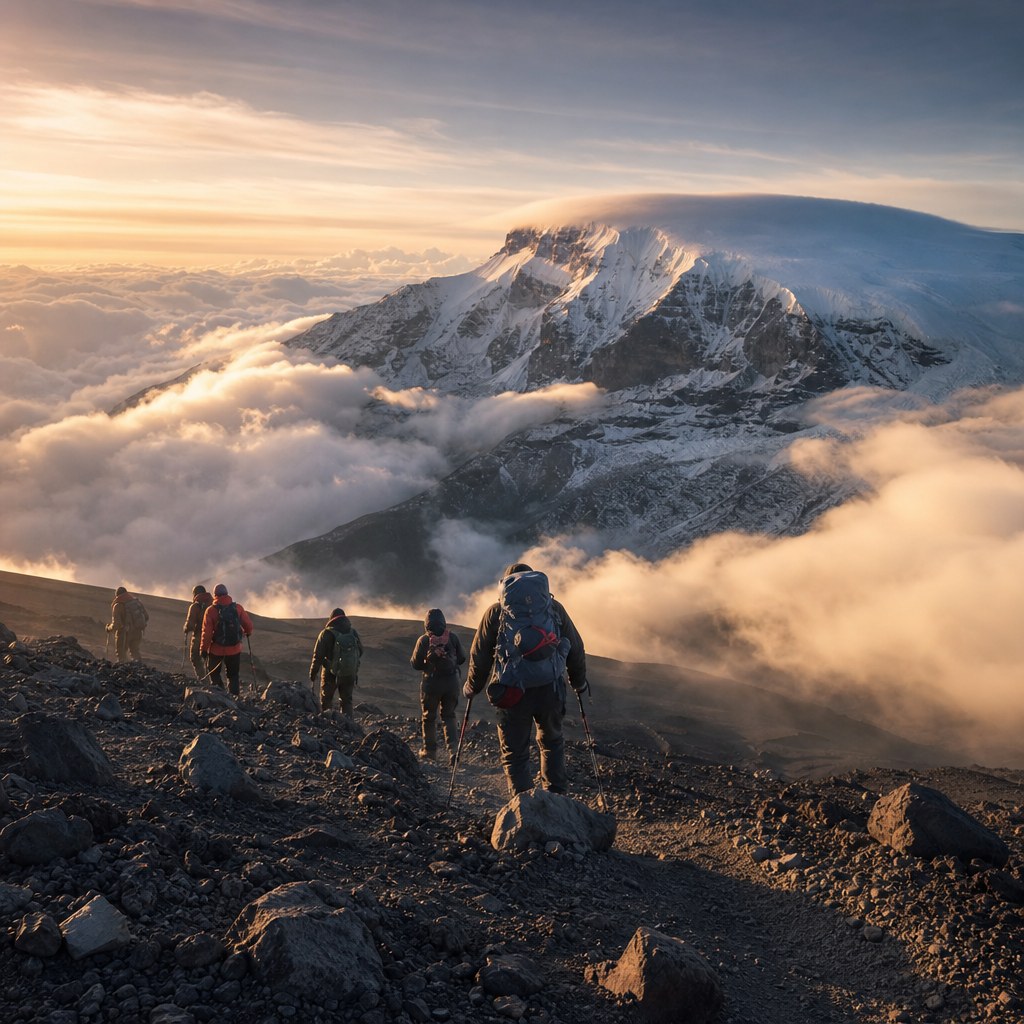
After breakfast at your Arusha or Moshi hotel, drive approximately 4-5 hours through scenic countryside to the Nale Moru Gate (1,950m) on the remote northern side of Kilimanjaro, near the Kenyan border. After completing park registration and meeting your trekking crew — lead guide, assistant guide, cook, and porters — the trail begins in cultivated farmland before entering beautiful montane forest. Unlike the busy Machame and Marangu starting points, you will likely have the trail entirely to yourself. The path climbs gently through towering trees draped in old man's beard lichen, with the possibility of spotting colobus monkeys and even the occasional elephant track in the mud. The 8 km trek to Rongai One Camp (2,600m) takes approximately 3-4 hours. Arrive at camp in the early afternoon with time to rest and enjoy the peaceful forest surroundings. This is the quietest trailhead on Kilimanjaro.
Leave the forest behind as the trail transitions into rolling moorland with sweeping views of the Kenyan plains stretching northward. The landscape opens up dramatically, with giant heather and tussock grass covering the hillsides. Today's climb is steady and moderate, passing the Second Cave (3,450m) where you'll stop for a brief rest and snack. The trail then continues across the open moorland toward the jagged spires of Mawenzi Peak, which dominate the eastern skyline. The 12 km trek to Kikelelwa Camp (3,600m) takes approximately 5-6 hours. The camp sits in a sheltered hollow with stunning views of Mawenzi's volcanic spires — some of the most dramatic scenery on any Kilimanjaro route. Afternoon acclimatization walk recommended to a nearby ridge for even better views. The air is thinning noticeably — walk slowly, drink plenty of water, and enjoy the extraordinary solitude.
A shorter but steeper day as you climb from Kikelelwa Camp toward the dramatic Mawenzi Peak — Kilimanjaro's second-highest volcano at 5,149m. The trail ascends across rocky alpine terrain with sparse vegetation, and the views become increasingly spectacular. Mawenzi's jagged pinnacles and sheer rock faces tower above you, creating an almost alpine mountaineering atmosphere unique to this route. The 5 km trek to Mawenzi Tarn Camp (4,330m) takes approximately 3-4 hours, arriving by early afternoon. The camp is set beside a small tarn (mountain lake) directly beneath Mawenzi's spectacular eastern face — many consider this the most beautiful camp on Kilimanjaro. The afternoon is free for rest and acclimatization. Your guide will lead a short hike up to a nearby ridge at approximately 4,600m following the "climb high, sleep low" principle to prepare your body for summit night. This is a critical preparation day — the altitude is significant and you must stay hydrated and eat well.
Today is a dedicated acclimatization day — the key to our high summit success rate. Rather than pushing higher, you'll spend a full day at Mawenzi Tarn (4,330m), allowing your body to produce more red blood cells and adapt to the reduced oxygen at this altitude. After a leisurely breakfast, your guide will lead a 3-4 hour acclimatization hike up toward the Mawenzi saddle, reaching approximately 4,700m. This follows the proven "climb high, sleep low" principle — ascending to a higher altitude during the day stimulates adaptation, while returning to sleep at the lower camp altitude aids recovery. The views from the ridge are extraordinary — Kibo Peak rises across the saddle, its glaciers gleaming in the sun, while Mawenzi's volcanic pinnacles tower overhead. Return to camp for lunch, then spend the afternoon resting, reading, photographing the dramatic surroundings, and drinking plenty of fluids. Your guide will check your oxygen saturation and heart rate, and brief you on the days ahead. This rest day makes the difference between summiting and turning back.
Leave Mawenzi Tarn and cross the dramatic "Saddle" — the wide, flat alpine desert between the twin volcanic peaks of Mawenzi and Kibo. This is an otherworldly landscape of volcanic rock, scattered boulders, and sparse lichen, with virtually no vegetation at this altitude. The trail is long and gradual, with Kibo Peak growing ever larger as you approach across the plateau. The sense of anticipation builds — tomorrow is summit night. The 8 km trek to Kibo Hut (4,700m) takes approximately 4-5 hours, arriving by early afternoon. Kibo Hut is a stone A-frame shelter (though we still use tents) at the base of the final ascent cone. This is base camp for the summit push. Rest, hydrate, and eat as much as possible. Your guide will conduct a thorough gear check and summit briefing — you'll learn the timing, pace, and strategy for the night ahead. An early dinner is served, and you'll be encouraged to sleep by 6:00 PM. The midnight wake-up call will come before you know it.
Midnight arrives, and your guide wakes you for the summit push. Dressed in every layer you have, headlamp cutting through the darkness, you begin the grueling 1,195-meter ascent to Uhuru Peak. The trail climbs steeply through volcanic scree, zigzagging up the frozen slope between Hans Meyer Point (5,140m) and Gillman's Point (5,681m) on the crater rim. The physical and mental challenge is immense — cold, darkness, altitude, and fatigue test every fiber of your being. But as dawn breaks near Gillman's Point, the most spectacular sunrise in Africa unfolds before you — the curvature of the Earth visible on the horizon, Mawenzi Peak glowing orange across the saddle, and the vast African plains stretching endlessly below. From Gillman's Point, continue along the crater rim through snow fields and past the retreating glaciers to Uhuru Peak (5,895m) — the highest point on the African continent. Photos, tears, triumph. After savoring the summit, descend via the Marangu Route — first back to Kibo Hut for a brief rest, then continue down through the alpine desert to Horombo Hut (3,720m). A 14-16 hour day, but one you'll remember for the rest of your life.
Wake up at Horombo Hut (3,720m) with the satisfaction of having conquered Africa's highest peak. Today is a gentle descent through the changing landscapes of the Marangu Route on Kilimanjaro's southern side — a completely different perspective from the northern approach. The trail descends through alpine moorland, passing giant senecio forests and heather-covered slopes. You'll notice the air growing thicker and warmer with every step downward — a welcome relief after the extreme altitude. The 14 km trek to Mandara Hut (2,700m) takes approximately 5-6 hours. Mandara Hut sits at the edge of the montane forest, and in the afternoon you can take an optional 30-minute walk to Maundi Crater, a small volcanic crater with beautiful views of the surrounding area and sometimes even glimpses of the summit you stood upon yesterday. Enjoy a celebratory dinner with your team at the hut — the hardest days are behind you.
The final descent through lush montane rainforest to Marangu Gate (1,830m) takes approximately 3-4 hours. The trail winds through towering trees festooned with moss and epiphytes, with birdsong replacing the silence of the high camps. The air is rich and warm — a stark contrast to the frozen world of the summit. Colobus monkeys crash through the canopy overhead, and colorful turacos flash between branches. At Marangu Gate, sign the official register and receive your hard-earned summit certificate — gold for Uhuru Peak, green for Gillman's Point. This is a moment of immense pride and emotion. Your porter team will gather to sing the traditional Kilimanjaro song ("Hakuna Matata") in celebration of your achievement. A vehicle will be waiting to drive you back to your hotel in Moshi or Arusha, where a hot shower, cold drink, and comfortable bed await. For those wanting to extend their adventure, we can arrange a wildlife safari or Zanzibar beach extension — the perfect reward after your climb.
Prices are per person. Private treks and group joins available. All prices include park fees, rescue fees, and full crew support.
| Season | Option | Group Size | Price (PP) | Single Tent | Status |
|---|---|---|---|---|---|
| Low Season Apr-May, Nov | Group Join | 4-12 people | $3,560 | $150 | Available |
| Private | 2-3 people | $4,200 | Included | Available | |
| High Season Jan-Mar, Jun-Oct | Group Join | 4-12 people | $3,860 | $150 | Available |
| Private | 2-3 people | $4,500 | Included | Available | |
| Peak Season Jul-Aug, Dec | Group Join | 4-12 people | $4,060 | $150 | Available |
| Private | 2-3 people | $4,800 | Included | Available |
Our 8-day itinerary with the Mawenzi Tarn acclimatization day achieves over 90% summit success. All prices include Kilimanjaro National Park fees, rescue fees, guide and porter team, meals, and camping equipment.
| Day | Camp / Hut | Altitude | Zone | Type |
|---|---|---|---|---|
| Day 1 | Rongai One Camp | 2,600m | Montane Forest | Camping |
| Day 2 | Kikelelwa Camp | 3,600m | Moorland | Camping |
| Day 3 | Mawenzi Tarn Camp | 4,330m | Alpine Desert | Camping |
| Day 4 | Mawenzi Tarn Camp | 4,330m | Alpine Desert | Camping (acclimatization) |
| Day 5 | Kibo Hut | 4,700m | Alpine Desert / Arctic | Camping near hut |
| Day 6 | Horombo Hut | 3,720m | Moorland | A-frame hut |
| Day 7 | Mandara Hut | 2,700m | Montane Forest | A-frame hut |
Fly into Kilimanjaro International Airport (JRO), approximately 40 km from Moshi and 60 km from Arusha. Airlines serving JRO include KLM (Amsterdam), Ethiopian Airlines (Addis Ababa), Qatar Airways (Doha), Turkish Airlines (Istanbul), Kenya Airways (Nairobi), and Precision Air (Dar es Salaam). We include one night's pre-trek accommodation in Moshi, so plan to arrive at least one day before the trek begins. We can also arrange airport transfers for $50 each way.
We provide complimentary pickup from any hotel in Arusha or Moshi, or from Kilimanjaro International Airport. The drive to the Rongai trailhead (Nale Moru Gate) takes approximately 3.5-4 hours from Arusha or 2.5-3 hours from Moshi, passing through beautiful Tanzanian countryside and near the Kenyan border. Departure time is typically 7:00 AM on Day 1 to allow sufficient trekking time.
We provide a detailed packing list upon booking. Essential items include: waterproof trekking boots (broken in!), 4-season sleeping bag (-10°C rating), down jacket, thermal base layers, waterproof shell jacket and pants, headlamp with spare batteries, trekking poles, warm hat and gloves, and a 30-40L daypack. Rental equipment is available in Moshi at reasonable prices — we can arrange sleeping bag ($50), poles ($20), and down jacket ($40) rentals.
Most nationalities can obtain a visa on arrival at JRO for USD $50 (USD $100 for US citizens). A valid passport with at least 6 months remaining and two blank pages is required. Mandatory travel insurance covering high-altitude trekking and helicopter evacuation must be obtained before the trek. Yellow fever vaccination certificate is required if arriving from endemic areas.
Arusha, Tanzania • Established 2015
Nashivai Safaris is a locally owned and operated safari and trekking company based in Arusha, Tanzania. Our Kilimanjaro division is led by guides who have summited over 200 times each, and our porter team is among the best-treated on the mountain — we exceed KPAP fair-treatment standards. The Rongai Route is one of our specialty treks, and our 8-day itinerary with the Mawenzi Tarn acclimatization day achieves a 90%+ summit success rate. The remote northern approach offers a uniquely peaceful Kilimanjaro experience that we are proud to share with our clients.
"The Rongai Route was the perfect choice for us — we barely saw another trekker for the first four days! The camp at Mawenzi Tarn is absolutely magical, sitting right beneath those incredible rock spires. Our guide Peter was phenomenal — his calm encouragement during the summit push made all the difference. The extra acclimatization day was worth every penny. All 6 of us in the group made it to Uhuru Peak!"
— Sarah T., Australia • February 2025"I chose Rongai because I wanted a quieter experience than the crowded Machame Route, and it delivered beautifully. The northern approach has a completely different feel — drier, more remote, with views into Kenya. The Mawenzi Tarn rest day was crucial; I felt strong going into summit night. Descending via Marangu was a nice contrast, seeing the lush southern side. Nashivai's team was impeccable — well-fed, well-guided, and well-cared-for throughout."
— David K., Canada • September 2024