
Mount Meru is Tanzania's second-highest mountain and Africa's fifth-highest peak, rising dramatically to 4,566 metres within Arusha National Park. Often overshadowed by its famous neighbour Kilimanjaro, Meru is a spectacular volcanic cone in its own right — a genuine hidden gem that rewards climbers with a wilderness experience far removed from the crowds of the more popular routes. The trek begins at Momella Gate and ascends through diverse ecological zones where wildlife roams freely: buffalo, giraffe, warthog, colobus monkeys, and even leopard inhabit the lower slopes, making this the only major mountain trek in East Africa where you'll share the trail with large game. An armed park ranger accompanies every group as a mandatory safety requirement, adding to the sense of genuine adventure. The summit push to Socialist Peak follows a thrilling technical ridge walk along the crater rim — not extreme, but exhilarating — with sunrise views of Kilimanjaro that are widely regarded as the finest in all of Tanzania. For those planning a Kilimanjaro climb, Meru is the perfect preparation: it provides real altitude adaptation, tests your gear and fitness, and offers an unforgettable experience in its own right.
Buffalo, giraffe, colobus monkeys
Perfect prep 1 week before Kili
Kilimanjaro view from Socialist Peak
Far fewer climbers than Kilimanjaro
The best climbing seasons for Mount Meru are the dry months of June through October and January through February. Because the lower slopes pass through a wildlife-rich rainforest zone, the trail can become muddy and slippery during the long rainy season of March through May and the short rains of November. June to October offers the most stable weather, cooler temperatures, and excellent visibility — ideal conditions for the famous sunrise view of Kilimanjaro from Socialist Peak. January and February are warmer and also provide clear skies. We strongly recommend avoiding April and May, when heavy rainfall makes the forest trails difficult and the crater rim ridge walk can be dangerous in poor visibility. If you are climbing Meru as acclimatization before Kilimanjaro, scheduling Meru 5 to 7 days before your Kili climb provides optimal altitude adaptation benefits.
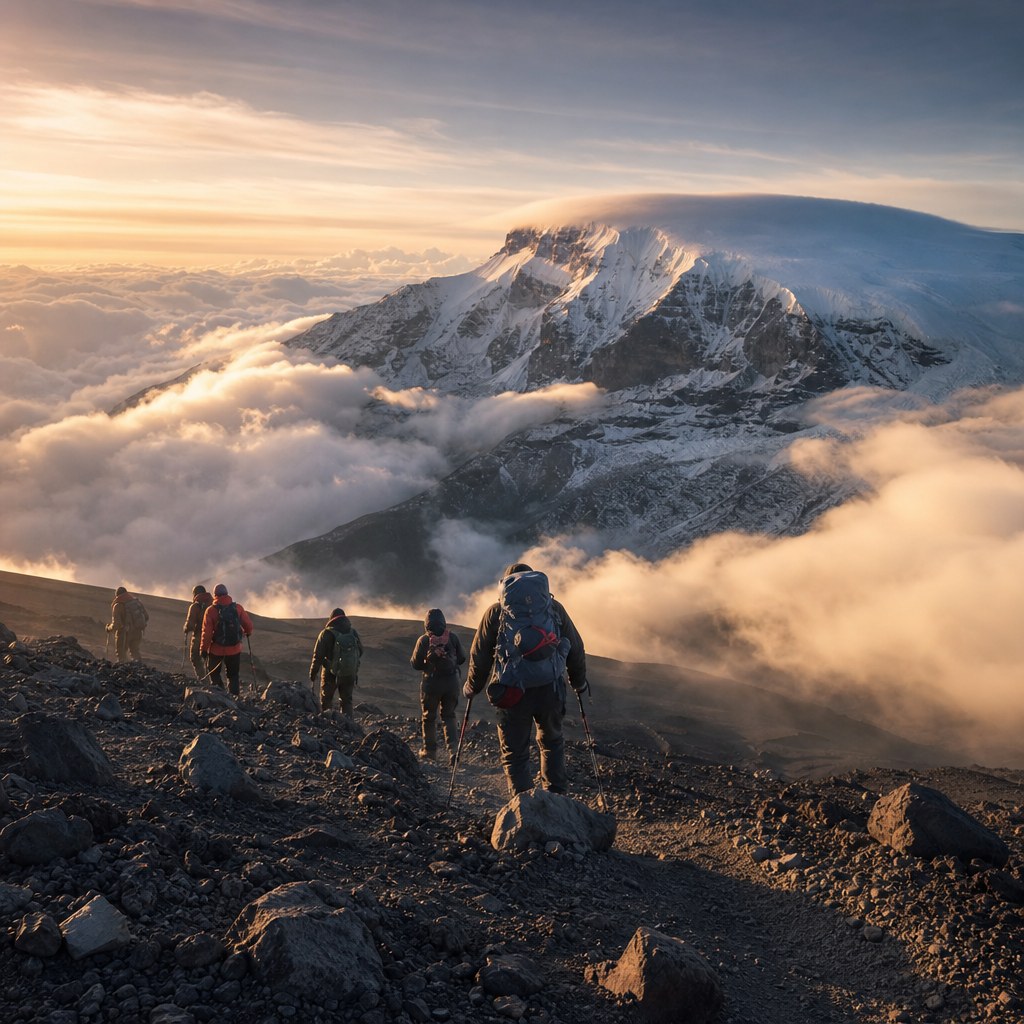
After breakfast at your hotel in Arusha, you'll drive approximately 90 minutes to Momella Gate (1,500m) within Arusha National Park. After completing park registration and meeting your armed park ranger — a mandatory escort on all Meru treks due to the abundance of wildlife — the ascent begins. The trail winds through open grassland and dense montane forest where you're likely to encounter grazing buffalo, families of giraffe, warthogs, and playful colobus monkeys in the canopy above. The forest is alive with bird song and the rustle of unseen animals, creating an atmosphere unlike any other mountain trek in Africa. You'll cross the Maio River and continue through fig tree arches and towering cedars to reach Miriakamba Hut (2,515m) in 3 to 4 hours. The hut is a comfortable shared cabin with bunk beds and a dining area, set in a beautiful clearing above the forest. After dinner, enjoy the sounds of the forest as night falls — buffalo often graze near the hut after dark, and the ranger keeps watch throughout the night.
After a warm breakfast at Miriakamba Hut, the trail steepens as you leave the forest behind and ascend through the heather and moorland zone. The vegetation transitions dramatically — giant heather trees give way to tussock grasses and everlastings as you gain altitude. The path follows a ridge with increasingly expansive views of the Meru crater and the sheer cliffs of the inner wall. After 2 to 3 hours, you reach Saddle Hut (3,570m), positioned in the dramatic saddle between Meru's main peak and Little Meru. After lunch and a rest at the hut, there's an optional acclimatization hike to the summit of Little Meru (3,820m), which takes about 1 to 1.5 hours round trip and provides stunning views over the Ash Cone and the entire crater. This short hike is highly recommended — not only for the views and altitude adaptation, but because it allows you to scout the first section of tomorrow's summit route. Return to Saddle Hut for an early dinner and rest, as the summit push begins just after midnight.
The summit push begins around midnight or 1:00 AM under a canopy of stars. The trail from Saddle Hut first crosses a saddle of loose volcanic gravel before reaching the base of the crater rim ridge. What follows is one of the most exhilarating sections of any mountain trek in Africa — a narrow ridge walk along the crater's edge with steep drop-offs on both sides. The ridge is exposed but not technically extreme; the ranger leads the way, and the sense of drama is immense as you inch upward in the darkness, headlamps carving a path through the cold mountain air. After 4 to 5 hours of steady climbing, you reach Socialist Peak (4,566m) just as the first light paints the eastern horizon. The sunrise from Meru's summit is legendary — as the sky ignites in gold and crimson, the massive silhouette of Kilimanjaro emerges from the clouds roughly 80 kilometres to the east, its glaciated peak catching the morning light. It's a view that many climbers consider even more beautiful than the summit view from Kilimanjaro itself. After celebrating and taking photographs, begin the descent along the same ridge — now visible in daylight and astonishingly dramatic — back to Saddle Hut for a brief rest and hot lunch. In the afternoon, continue descending to Miriakamba Hut (2,515m) for a well-earned night of rest at lower altitude.
After a final breakfast on the mountain, the descent to Momella Gate follows a different trail than the ascent, taking you through the northern route via the Tululusia Falls — a stunning waterfall cascading from the crater rim — and through the beautiful fig forest. The trail passes through the game zone once again, and wildlife sightings are common in the morning hours. Buffalo often stand near the trail, and colobus monkeys call from the trees above. The descent takes approximately 2 to 3 hours, arriving at Momella Gate by mid-morning. Here you'll complete park formalities, receive your official Mount Meru Summit Certificate, and say goodbye to your ranger, guide, and the mountain crew. A private vehicle transfers you back to Arusha (approximately 90 minutes), where you can celebrate your achievement with a hot shower and a cold drink. If you're continuing on to Kilimanjaro, this is the perfect time to rest and let the altitude adaptation settle in before beginning your Kili trek 5 to 7 days later.
All prices are per person and include Arusha National Park fees, armed ranger, guide, hut fees, meals, and transfers from Arusha. Prices vary by season and group type.
| Season | Dates | Group (2+ pax) | Private (1 pax) |
|---|---|---|---|
| Low Season | Apr – May | $980 | $1,350 |
| Shoulder Season | Mar, Jun, Nov | $1,150 | $1,550 |
| High Season | Jul – Oct, Jan – Feb | $1,350 | $1,780 |
Book Meru as acclimatization before any Kilimanjaro climb and receive a 5% discount on the Meru portion. Many of our climbers do Meru 5–7 days before Kili for the best altitude adaptation. Ask us about combo pricing!
Fly into Kilimanjaro International Airport (JRO), approximately 60 km from Arusha. International connections are available through Qatar Airways (Doha), Turkish Airlines (Istanbul), KLM Royal Dutch Airlines (Amsterdam), Ethiopian Airlines (Addis Ababa), and Kenya Airways (Nairobi). Alternatively, Arusha has a small airstrip with domestic connections from Dar es Salaam, Zanzibar, and the Serengeti. Airport transfers are included in your package — our representative will meet you at arrivals.
If you're climbing Meru as preparation for Kilimanjaro, we recommend staying in Arusha before and after the trek. We can arrange accommodation at any of Arusha's hotels and lodges — from budget guesthouses to luxury properties. The drive from Arusha to Momella Gate takes approximately 90 minutes through scenic countryside and into Arusha National Park. On Day 4, you'll be transferred back to your Arusha accommodation. If you're combining Meru with a Kilimanjaro climb, we'll coordinate the schedule to allow 5–7 days of rest between treks for optimal acclimatization.
Mount Meru requires less gear than Kilimanjaro since you'll be sleeping in huts rather than tents. Essential items include: waterproof trekking boots (broken in), sleeping bag (rated -5°C minimum), warm layers for the summit push (down jacket, thermal base layers, warm hat and gloves), waterproof shell jacket, headlamp with spare batteries (essential for the midnight summit push), trekking poles, and a 30-40L daypack. Unlike Kilimanjaro, you won't need a sleeping mattress (huts provide them) or a tent. Any missing items can be rented in Arusha before the trek — sleeping bag ($30), down jacket ($25), trekking poles ($15).
Most nationalities can obtain a visa on arrival at JRO for USD $50 (USD $100 for US citizens). A valid passport with at least 6 months remaining and two blank pages is required. Mandatory travel insurance covering high-altitude trekking and emergency evacuation must be obtained before the trek. Yellow fever vaccination certificate is required if arriving from endemic areas. No special permits are needed beyond the standard Arusha National Park entry included in your package.
Arusha, Tanzania • Established 2015
Nashivai Safaris is a locally owned and operated safari and trekking company based in Arusha, Tanzania. Our Meru climbs are led by experienced guides who have summited Socialist Peak dozens of times and know every trail, every weather pattern, and every wildlife behaviour on the mountain. We provide the same high standard of care on Meru as we do on Kilimanjaro — professional guides, excellent meals, and genuine commitment to your safety and enjoyment. For climbers using Meru as Kilimanjaro preparation, our team coordinates both treks seamlessly, ensuring optimal rest and acclimatization between the two climbs.
Climbing Meru 5–7 days before Kilimanjaro is the best acclimatization strategy available. You'll adapt to altitude, test your gear, and arrive on Kili physically and mentally prepared — significantly boosting your summit chances.
No other major mountain trek in Africa takes you through big-game country. Buffalo, giraffe, warthog, and colobus monkeys share the trail — with an armed ranger escort ensuring safety while adding genuine adventure.
The sunrise view of Kilimanjaro from Socialist Peak is world-class — many climbers say it surpasses the view from Kilimanjaro's own summit. Combined with the thrilling crater rim ridge walk, Meru delivers an experience that stands entirely on its own merits.
"Mount Meru was the surprise highlight of our entire Tanzania trip. We did it as preparation for Kilimanjaro the following week, and honestly, it nearly stole the show. Walking through the forest with buffalo grazing 20 metres off the trail was surreal — our ranger was calm and professional, and we always felt safe. The ridge walk to the summit was the most thrilling thing I've ever done — narrow, exposed, with drops on both sides, but not difficult if you take your time. And that sunrise over Kilimanjaro? Absolutely unforgettable. Meru made our Kili climb feel so much easier — we both summited without any altitude issues. Do both!"
— Emma & James K., United Kingdom • August 2024"I climbed Meru on its own — not as Kili prep — and it was one of the best decisions I've made. The mountain is stunning, the huts are comfortable, and the fact that you share the trail with wildlife makes it completely unique. Our guide Yusuf was outstanding — knowledgeable about the flora and fauna, patient on the ridge, and an excellent cook. The summit night was intense but manageable, and reaching Socialist Peak as the sun came up over Kilimanjaro was pure magic. Far fewer people than Kili, more wild, more intimate. I can't recommend Meru highly enough."
— Sophie L., France • January 2025