
The Lemosho Route is widely considered the best overall Kilimanjaro route due to its pristine wilderness approach from the west, excellent acclimatization profile, and breathtaking scenery from start to summit. Beginning at the remote Lemosho Glades on Kilimanjaro's western side, the trail passes through untouched rainforest where buffalo and elephant are occasionally spotted — wildlife encounters rarely possible on other routes. The route then traverses the vast Shira Plateau before joining the Southern Circuit near Lava Tower, providing a proven "climb high, sleep low" acclimatization strategy. With a 90% summit success rate, the Lemosho Route is ideal for trekkers willing to invest more time for a richer, safer, and more rewarding Kilimanjaro experience. The diverse landscapes — from primeval rainforest to alpine desert to arctic summit — make this the most scenic and complete Kilimanjaro adventure available.
One of the highest on Kilimanjaro
Remote western approach, untouched forest
Climb high, sleep low at Lava Tower
Uhuru Peak — Africa's highest point
The best climbing seasons are the dry months of January through March and June through October. January-March offers warmer conditions with spectacular clear skies and the mountain's snow-capped peaks are at their most photogenic — an excellent time for the Lemosho approach through the pristine forest. June-October is cooler but dry and stable, with excellent visibility across the Shira Plateau. The rainy seasons of April-May and November-December should be avoided — the remote Lemosho forest trail can become extremely muddy and the Shira Plateau may be shrouded in thick mist, obscuring the dramatic views that make this route special. Because the Lemosho Route spends more time on the western side of the mountain, it benefits from slightly drier conditions than the eastern slopes. We particularly recommend January-February and September-October for the optimal combination of dry conditions, clear skies, and stunning visibility.
After breakfast at your hotel, transfer to the remote Lemosho Glades (2,100m) on Kilimanjaro's western side — a scenic drive of approximately two hours through lush farmland on the mountain's lower slopes. Complete park registration formalities at the gate and meet your full mountain crew — guide, assistant guides, cook, and porters who will be your support team for the next eight days. The trail immediately enters pristine montane rainforest that is rarely traveled and wonderfully untouched. This is one of the last remaining sections of virgin forest on Kilimanjaro, and the sense of primeval wilderness is palpable. Buffalo and elephant sightings are common here — a wildlife experience unique to the Lemosho Route. Giant trees tower overhead, their trunks wrapped in moss and epiphytes, while orchids and ferns carpet the forest floor. The 7 km trek to Forest Camp (2,780m) takes approximately 4-5 hours along a gentle, gradually ascending trail through this magical forest. You are unlikely to see any other trekkers today — this is the wild side of Kilimanjaro.
Today the trail climbs out of the rainforest and into the heather and moorland zone. The transition is dramatic — dense forest gives way to open slopes dotted with giant heather and protea, and the views open up spectacularly. As you ascend, the Shira Plateau comes into view — a vast volcanic caldera formed by Kilimanjaro's oldest collapsed volcano. The glaciated summit of Kibo rises dramatically above the plateau, your first unobstructed view of the mountain you are about to climb. The 9 km trek takes approximately 5-6 hours, arriving at Shira 1 Camp (3,610m) perched on the plateau's edge with panoramic views in every direction. The camp looks out across the plateau floor to the Cathedral and the Tower — dramatic volcanic formations — and westward to Mount Meru rising far in the distance. This is a significant altitude gain day, but the gentle gradient and stunning scenery make the hours pass quickly. Your guide will check your oxygen saturation and heart rate as part of the daily health monitoring.
A relatively gentle day as you traverse eastward across the vast Shira Plateau toward Shira 2 Camp (3,840m). This is one of the most scenic walks on the entire mountain — the plateau is a high-altitude semi-desert of volcanic rock, sparse vegetation, and dramatic skies. The massive cone of Kibo dominates the view ahead, its glaciers gleaming in the sunlight, while the jagged peaks of the Cathedral and the Tower rise to the north. You may spot augur buzzards soaring overhead and eland occasionally wandering across the plateau. The gentle gradient allows for relaxed walking and excellent acclimatization — you gain only 230 meters over 6 km in approximately 4-5 hours, following the proven "climb high, sleep low" principle. After lunch at Shira 2, your guide may offer an optional afternoon acclimatization hike toward the Cone Formation or along the plateau rim for additional altitude adaptation. Tonight's camp sits near the junction where several routes converge, but the atmosphere remains peaceful and the views are extraordinary.
This is the critical acclimatization day on the Lemosho Route — and one of the most dramatic. The trail climbs steeply from Shira 2 toward the imposing Lava Tower (4,630m), a towering volcanic plug that rises 90 meters from the surrounding slopes. The landscape becomes increasingly barren and otherworldly as you ascend into the alpine desert zone, with scattered volcanic boulders and virtually no vegetation. Stunning views of the Western Breach and the Southern Ice Fields open up as you approach the tower — you can see the route that early explorers used to reach the crater. Reaching Lava Tower is a significant achievement — at 4,630m you have "climbed high," and your body is working hard to adapt to the altitude. After lunch and rest at Lava Tower, the trail turns southeast and descends over 670 meters to Barranco Camp (3,960m) — the "sleep low" component that makes this acclimatization strategy so effective. Barranco Camp is widely considered the most scenic camp on Kilimanjaro, nestled beneath the imposing Barranco Wall with glaciers visible on Kibo's southern face. The 12 km trek takes approximately 7-8 hours. This day is the cornerstone of the Lemosho Route's excellent summit success rate.
Begin the day with the exciting ascent of the legendary Barranco Wall — the most thrilling and rewarding section on any Kilimanjaro route. This 257-meter near-vertical rock face looks intimidating from camp but is a non-technical scramble that rewards trekkers with some of the finest panoramic views on the entire mountain. With your guide's direction, you will use hands and feet to navigate the rocky ledges, and at the top the vista is breathtaking — clouds swirling below, glaciers gleaming above, and the vast African plains stretching to the horizon. After conquering the wall, the trail continues through valleys and ridges with magnificent views of glaciers and surrounding peaks before descending into the Karanga Valley and climbing to Karanga Camp (4,040m). The 5 km trek takes approximately 5-6 hours, giving you the afternoon to rest, hydrate, and let your body adjust to the altitude. Your guide will check your oxygen saturation and heart rate. This is a critical adaptation day — your body is producing the red blood cells needed for summit night.
A short but demanding ascent through the barren alpine desert brings you to Barafu Base Camp (4,673m), the final base camp before the summit push. The landscape is stark and otherworldly — volcanic rock, scattered boulders, and virtually no vegetation at this extreme altitude. The 4 km trek takes approximately 3-4 hours, arriving by early afternoon, which gives you crucial rest time before the midnight summit attempt. Your guide will conduct a detailed summit briefing — covering the timing, pacing, clothing layering strategy, and emergency procedures. Gear is checked one final time, and you are encouraged to eat and drink as much as possible. An early dinner is served, and you will be urged to sleep by 6:00 PM. The summit push begins around midnight. Rest well — tomorrow you will stand on the highest point in Africa.
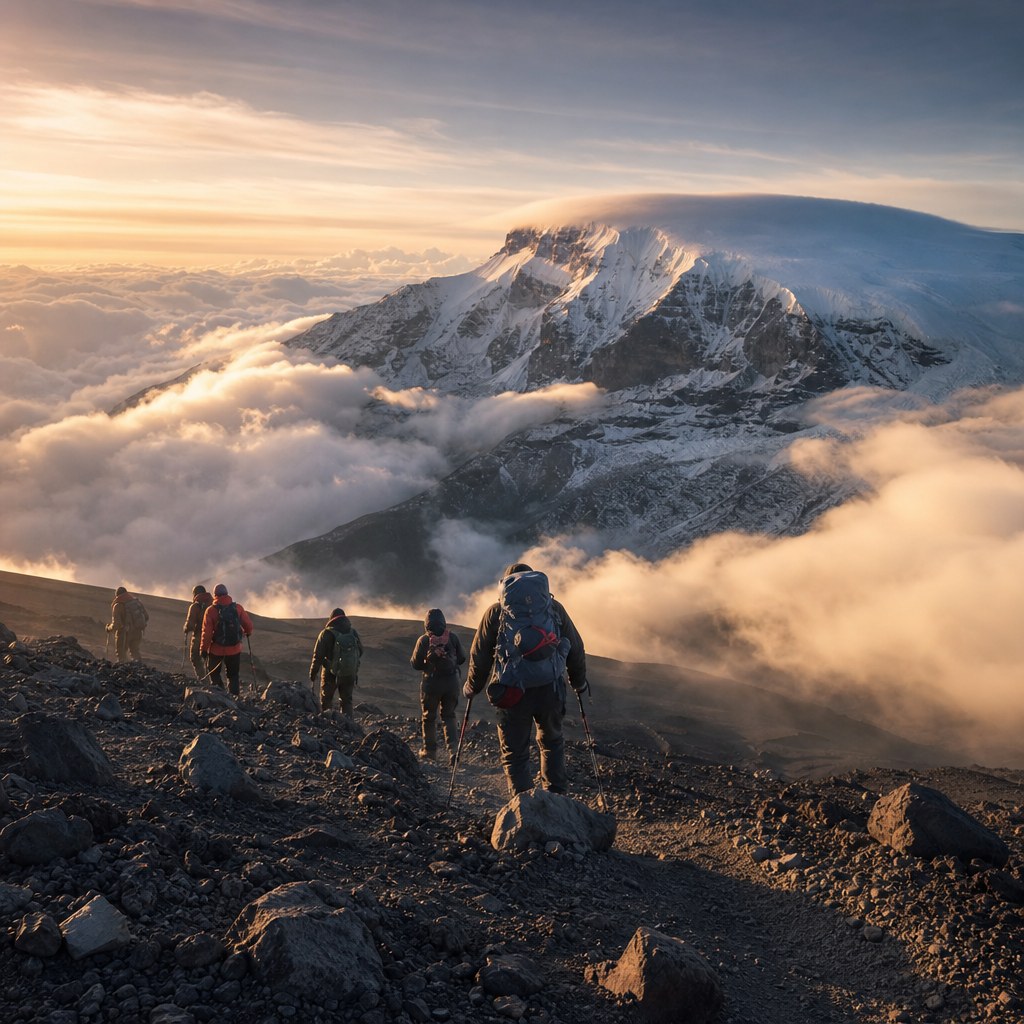
Around midnight, your guide wakes you for the summit push. Dressed in every layer you possess, headlamp cutting through the darkness, you begin the grueling 1,222-meter ascent toward Uhuru Peak. The trail climbs steeply through volcanic scree and snow fields, switchbacking endlessly upward between Stella Point (5,739m) and the summit. The physical and mental challenge is immense — cold, darkness, altitude, and fatigue test every fiber of your being. But as dawn breaks near Stella Point, the most spectacular sunrise in Africa unfolds before you — the curvature of the Earth visible on the horizon, Mawenzi Peak glowing orange across the saddle, and the vast African plains stretching endlessly below. From Stella Point, continue along the crater rim through snow fields and past the retreating glaciers to Uhuru Peak (5,895m) — the highest point on the African continent. Photos, tears, triumph. The Lemosho Route's excellent acclimatization pays dividends here — you feel strong and alert, not merely surviving. After summit celebrations and official photographs, descend to Barafu Camp for refreshments before continuing down to Millennium Camp (3,820m) for a well-earned rest. A 14-18 hour day, but one that will live in your memory for the rest of your life.
Enjoy your final morning on the mountain before descending through lush rainforest to Mweka Gate (1,640m). The trail is steep and can be muddy — trekking poles are essential. As you descend, the air thickens, the vegetation becomes denser, and birdsong replaces the silence of the high camps. The 8 km trek takes approximately 3-4 hours. Upon arrival at Mweka Gate, successful climbers will receive their Official Kilimanjaro National Park Summit Certificate during a special certificate presentation ceremony recognizing their achievement of reaching Africa's highest peak — gold for Uhuru Peak, green for Stella Point. Your porter team will gather to sing the traditional Kilimanjaro song in celebration. Bid farewell to your mountain crew before transferring to your hotel in Moshi or Arusha for a well-deserved celebration and recuperation. You have earned achievements that will last a lifetime.
Prices are per person. Private treks and group joins available. All prices include park fees, rescue fees, and full crew support.
| Season | Option | Group Size | Price (PP) | Single Tent | Status |
|---|---|---|---|---|---|
| Low Season Apr-May, Nov | Group Join | 4-12 people | $2,600 | $150 | Available |
| Private | 2-3 people | $3,200 | Included | Available | |
| High Season Jan-Mar, Jun-Oct | Group Join | 4-12 people | $2,850 | $150 | Available |
| Private | 2-3 people | $3,450 | Included | Available | |
| Peak Season Jul-Aug, Dec | Group Join | 4-12 people | $3,050 | $150 | Available |
| Private | 2-3 people | $3,650 | Included | Available |
Our 8-day Lemosho itinerary with the proven "climb high, sleep low" acclimatization at Lava Tower and the Southern Circuit approach provides one of the highest summit success rates on Kilimanjaro. All prices include Kilimanjaro National Park fees, rescue fees, guide and porter team, meals, and camping equipment.
| Day | Camp | Altitude | Zone |
|---|---|---|---|
| Day 1 | Forest Camp | 2,780m | Montane Rainforest |
| Day 2 | Shira 1 Camp | 3,610m | Heather / Moorland |
| Day 3 | Shira 2 Camp | 3,840m | Shira Plateau |
| Day 4 | Barranco Camp | 3,960m | Moorland / Alpine Desert |
| Day 5 | Karanga Camp | 4,040m | Alpine Desert |
| Day 6 | Barafu Camp | 4,673m | Alpine Desert / Arctic |
| Day 7 | Millennium Camp | 3,820m | Rainforest |
Fly into Kilimanjaro International Airport (JRO), approximately 40 km from Moshi and 60 km from Arusha. International connections are available through Qatar Airways (Doha), Turkish Airlines (Istanbul), KLM Royal Dutch Airlines (Amsterdam), Ethiopian Airlines (Addis Ababa), and Kenya Airways (Nairobi). Airport transfers can be arranged upon request.
We recommend staying in Moshi the night before your trek. The drive from Moshi to the Lemosho Glades trailhead takes approximately two hours through the beautiful foothills on Kilimanjaro's western slopes. We can arrange hotel bookings and transfers upon request. Departure to Lemosho Glades is at approximately 7:30 AM on Day 1.
We provide a detailed packing list upon booking. Because the Lemosho Route traverses multiple climate zones with rapidly changing conditions, comprehensive gear is essential. Key items include: waterproof trekking boots (broken in!), 4-season sleeping bag (-10°C rating), down jacket, thermal base layers, waterproof shell jacket and pants, headlamp with spare batteries, trekking poles (essential for the Barranco Wall and descent), warm hat and gloves, and a 30-40L daypack. Rental equipment is available in Moshi — sleeping bag ($50), down jacket ($40), and poles ($20).
Most nationalities can obtain a visa on arrival at JRO for USD $50 (USD $100 for US citizens). A valid passport with at least 6 months remaining and two blank pages is required. Mandatory travel insurance covering high-altitude trekking and helicopter evacuation must be obtained before the trek. Yellow fever vaccination certificate is required if arriving from endemic areas.
Arusha, Tanzania • Established 2015
Nashivai Safaris is a locally owned and operated safari and trekking company based in Arusha, Tanzania. Our Kilimanjaro division is led by guides who have summited over 200 times each, and our porter team is among the best-treated on the mountain — we exceed KPAP fair-treatment standards and are committed to ethical trekking practices. The Lemosho Route is our recommended choice for trekkers seeking the best overall Kilimanjaro experience. With its pristine wilderness approach, proven acclimatization at Lava Tower, and 90% summit success rate, this itinerary delivers the most rewarding and complete Kilimanjaro adventure available.
The Lemosho Route's "climb high, sleep low" approach at Lava Tower provides exceptional acclimatization, resulting in one of the highest summit success rates on Kilimanjaro.
The remote Lemosho Glades trailhead accesses untouched rainforest rarely visited by other trekkers. Wildlife encounters with buffalo and elephant are possible on the first day.
From pristine forest to the vast Shira Plateau, the dramatic Lava Tower, the thrilling Barranco Wall, and the summit approach — no route offers more diverse and breathtaking scenery.
"The Lemosho Route exceeded every expectation. The first day through the untouched forest was magical — we saw a family of buffalo just off the trail, which our guide said is common on this side of the mountain but rarely seen on other routes. Crossing the Shira Plateau felt like walking on another planet, and the Barranco Wall was the most fun I've ever had on a mountain. The acclimatization day at Lava Tower made all the difference — I felt strong and clear-headed on summit night. Nashivai's team was exceptional from start to finish."
— Jennifer & Mark T., United States • February 2025"I researched every Kilimanjaro route extensively before choosing Lemosho, and it was the right decision. The scenery changes every single day — rainforest, heather, plateau, lava tower, barranco wall, alpine desert, and finally the summit. No other route offers such variety. The 90% success rate is real — everyone in our group of eight made it to Uhuru Peak. Our guide Thomas was incredible, checking our oxygen levels twice daily and adjusting the pace perfectly. The private flush toilet tent was an unexpected luxury. Highly recommend this route and this company."
— Dr. Priya S., India • September 2024